Bike Boulevard
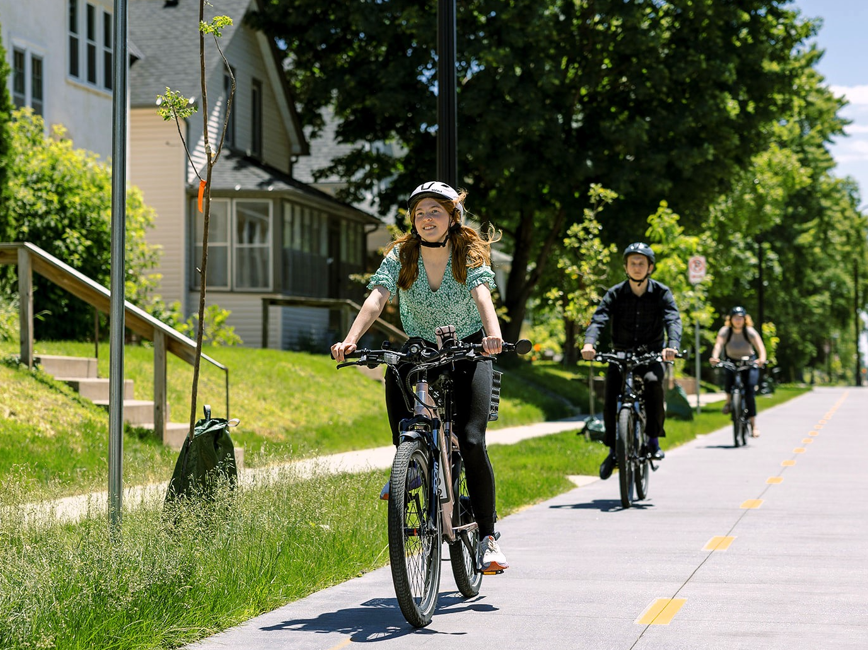
A bicycle boulevard is a lower-volume, lower-speed street that has been optimized for bicycle traffic. The purpose of a bicycle boulevard is to provide bicyclists, especially those who are not comfortable riding on busy streets a safer and more relaxing place to ride. While many residential streets are already favorable to most bicyclists, a bicycle boulevard goes the extra step to provide safe crossings at major streets and encourage motorists to travel at slow speeds, while reducing the frequency of stop signs.
This environment is created through a variety of traffic calming and design elements such as speed humps, traffic circles, curb extensions, medians, and traffic signals. Many of the changes, especially the intersection treatments, improve safety for pedestrians and motorists, too. Bicycle boulevards are designated with pavement markings that include a large bicycle symbol with the text “BLVD.”
When you drive:
- You are allowed to drive on and over bicycle boulevard pavement markings.
- If you find yourself driving behind a bicyclist and need to pass, only overtake the bicyclist at a safe speed and only if there is a legally safe passing distance of at least 3 feet.
- Motor vehicles are permitted on almost all portions of bicycle boulevards unless signs or pavement markings indicate otherwise. Turning from or onto a bicycle boulevard is restricted at some intersections.
When you bike:
- While a bicycle boulevard prioritizes bicycle traffic, you must still obey all traffic signs and signals. Bicyclists must yield to pedestrians and motorists who have the right-of-way.

Download printer-friendly versions of these materials:
Last updated Feb. 1, 2012