
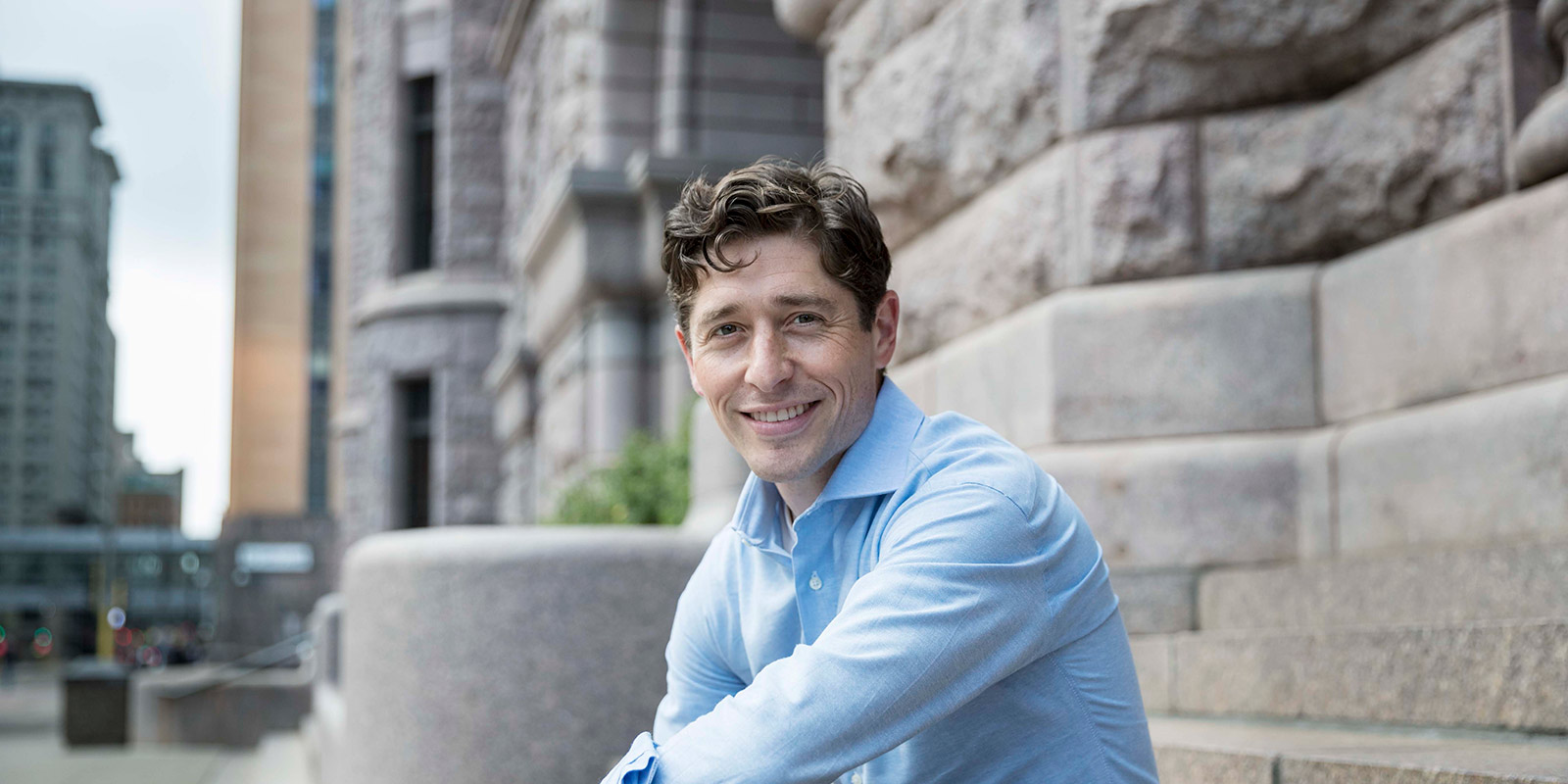
2007 State of the City Address

"Minneapolis: A City that Values its Strong Middle Class"

Mayor R.T. Rybak

Tuesday, March 19, 2007

It’s appropriate that the City and this campus are connected by a bridge because the University of Minnesota and Minneapolis have always been linked by bridges of opportunity. I love walking across the Washington Avenue bridge to take in one of the best views in the city, which is about to get even better with Frank Gehry’s addition to his spectacular Weisman Museum.

The view is so impressive that I doubt many people stop to look down at a fairly non-descript strip of land on the water’s edge of the West Bank. That land was once known as Bohemian Flats and it’s where immigrants like my great grandfather came from what is now the Czech Republic before many of them moved to farming communities like Montgomery or New Prague.

I doubt my father spent much time thinking about the previous generation at Bohemian Flats when he moved back from New Prague to Minneapolis to enroll at the University’s School of Pharmacy. He was looking, instead, to the future. He used his degree from the U to become the manager of the downtown Walgreen’s and later owner of his own drug store. He made enough money along the way to buy a house with my mother in what was then a middle class neighborhood in southwest Minneapolis.

This story is not unique. For my father, and hundreds of thousands of graduates before and after him, the University of Minnesota was a bridge to opportunity. The graduates of the University have gone on to greatness in every field, and some have become extraordinarily wealthy. But most were like my father, who used their University education as a path into the middle class.

Minneapolis, in turn, gave those University graduates the opportunity to prosper in some of the most livable middle class neighborhoods of any city in America. So the University has played a pivotal role in one of the most unique characteristics of Minneapolis: it’s strong and vast middle class.

Every city has rich neighborhoods filled with rich people and poor neighborhoods filled with poor people. Minneapolis has both. But Minneapolis is exceptional in American cities today in that it is made up mostly of miles and miles of strong, safe middle-class neighborhoods. Minneapolis remains a place where opportunity still provides a path into the middle class and we need to keep this vision alive. This vision is what keeps us from being separated into a city of rich and poor like so many large cities in America today.

The history of Minneapolis is not a story of rich and poor separated by a yawning gap. The story of Minneapolis is about a city of bridges to opportunity, in education, in jobs, in neighborhoods: many peoples from many places becoming one people in one place, woven together in ways that helped each of them succeed.

Think about the history of our city: Riverfront mills, powered by the working poor, mostly immigrants, became so successful that Minneapolis became the milling capital of the world. Growing out of those mills were corporations like General Mills and Pillsbury and scores of related businesses. Workers in those mills and those companies bought homes and created strong, safe neighborhoods in every part of Minneapolis – places like Longfellow, Seward, Camden, Bottineau, Audubon Park, Armatage, Standish-Erickson and Hale-Page-Diamond Lake.

These neighborhoods form the mortar of a city, acting as the crossroads of culture that connect the rich and the poor. When we lose the middle class we lose that connection and risk becoming a city where people may live in the same place but exist in different worlds.

Like a canary in a coal mine, the health of a middle class can tell us what direction our city is heading, and if we read the trends today in our middle class neighborhoods we see Minneapolis moving in two directions at once. Some Minneapolis middle class neighborhoods have lost homeowners and have seen crime rise. A block once filled with diligent homeowners who kept up their property may now have a boarded home and graffiti in the alley. Some Minneapolis middle class neighborhoods are moving in the other direction: they have become so desirable that housing prices have skyrocketed, where almost every block has homes undergoing major renovation or are even being torn down to be replaced by larger homes.

Each of these two separate experiences creates its own challenges. In those middle class neighborhoods under siege, the homeowners who remain sometimes give up, move out and make the downward spiral move even faster. In those becoming rapidly more expensive, homeowners may have dramatically more equity in their home, but their property tax values are going up and it’s less likely their children can afford a home in the neighborhood where they grew up.

Each situation also has its opportunities. Some of those neighborhoods that seem to be moving in the wrong direction happen to also have some of our best housing stock and if we can reverse the trends in crime and deterioration, these blocks offer some of our best options for new middle class homeowners to find affordable places to buy in the city. The neighborhoods where values are escalating rapidly are obviously generating much more property revenue for the city, and all that private investment in the homes almost guarantees these neighborhoods will be strong for many years.

While some middle class neighborhoods seem to be moving in one of these two directions, most are somewhere in the middle and those of us who live there see what seem to be conflicting signs of the direction we are headed…a crime happens disturbingly close to our home while a neighboring house sells for more than we ever dreamed; graffiti in the alley while neighbors are putting on pricey new additions.

Amidst these conflicting signals lies the reality that our city is growing, our city is prospering, and our city continues to maintain one of the largest and strongest middle classes of any large city in America.

According to the Brookings Institution, which has been tracking household income data for over twenty years, Minneapolis has an especially large, strong middle class, which has maintained relatively stable since 1979. Moreover, Minneapolis’ ability to keep its large, strong middle class makes us special among large American cities. Of one hundred cities studied in this report, Minneapolis was identified in a special class of cities with a particularly large, stable middle class, unlike the case for many cities, including Atlanta, Cleveland, Philadelphia or Cincinnati.

Minneapolis is growing again: more people are living here, more are relocating here, more are investing here, more are working here and more are playing here than a generation ago. The question is now about how we guide our growth in a way that supports our values and maintains our strong middle class neighborhoods with bridges of opportunity. Building and keeping a strong middle-class means creating a city:

A Safe Place to call home.

Making Minneapolis a safe place to call home has been our highest priority and will continue to be. We can’t rest until it is safe for every person to walk safely down every street in our city. We have a long way to go before that can happen.

Like most large cities in America today, Minneapolis continues to face violent crime that is too high. And the most troubling part of this problem is that the crime we are fighting too often involves violent, heavily armed young people who are being recruited into smaller, more numerous, more flexible, more violent gangs. Added to this is a breakdown of family, the proliferation of illegal guns coming into our city, a culture of violence and retaliation among hopeless youth, and state and federal budget cuts that have lacerated crime enforcement and prevention programs. Left in the wings are too may kids raising themselves and too many kids having kids of their own.

We have met the challenge of crime with a multi-faceted plan of attack that has begun to crack down on repeat criminals, break up juvenile gangs and reform problem properties. The most immediate and powerful tool in our crime fighting strategy has been increasing the visibility and presence of police officers on the street. We are growing our police force by over 100 officers, returning to the level we had in 2002 – a significant achievement accomplished despite a slowed economy, the end of federal public safety funding and $30 million less from the state each year. With new police hires, we are also making sure that our police department reflects the diversity of the community it serves. In fact, while our entire police department has now reached an historic high of nearly 18% people of color, 32% of the new classes of police officers hired in the last year have been people of color.

To a larger more diverse, more visible police force, we added groundbreaking public safety technology that is already showing results. The addition of dozens of safety cameras and dramatically increased police patrol has made our downtown one of the safest in America. The safety cameras we added at Cedar-Riverside have helped provide essential evidence to arrest and successfully charge criminals. The ShotSpotter gunfire detection technology along key parts of south central Minneapolis led to three felony arrests, three misdemeanor arrests, two recovered guns and a recovered stolen car – all in the first month of operation.

Our stronger, better equipped police force has also improved its collaboration with other law enforcement agencies to focus on chronic offenders with the Violent Offenders Task Force. This has helped our police be more effective on the street. Police arrests were up 22 percent in 2006 compared to the previous year and up 41 percent in the 4th precinct of north Minneapolis, where so much of our efforts have been concentrated.

Our tougher enforcement strategies are strengthened even further because we are helping our officers more effectively get criminal cases charged. The technology we are implementing increases prosecutions by providing needed court evidence, but we also invested in better prosecution with more funding for community prosecutors in police precincts to increase crime convictions. The results of this effort are dramatic. The number of our most chronic criminals who commit a disproportionately high number of crimes, who were convicted has increased from 81 convictions in 2005 to 129 convictions in 2006 – a 60% increase in one year.

We have had successes in our fight to make every part of Minneapolis a safe place to call home. But we have a long, long way to go, and we will continue to make public safety our top priority.

The largest driver behind our increased crime has been violent young people. We are sending a strong message to these young offenders – especially those in the barbaric gangs responsible for random deaths – that no matter how old you are you will be held accountable. Our new Juvenile Crime Unit significantly increased arrests and successful charges by coordinating information on chronic juvenile offenders and immediately connecting troubled youth to social service programs that help them transition out of crime. In the Juvenile Unit’s first two months of operation, the number of arrests of juvenile offenders committing robberies and aggravated assaults increased an astonishing 115% and the number of juvenile offenders charged with robberies and aggravated assaults increased 50% compared to 2005. By the end of 2006, 313 juveniles were arrested for violent crimes – a 26% increase from the year before. As a result, juvenile offenders are more likely to be charged with a strong case, while also get connected to support systems to prevent repeat crimes.

When facing violent criminals, we need to be tough. We also know the smartest crime fighting strategy is to prevent crime in the first place. The best crime prevention strategies not only prevent crime right now, but lay the foundation to keep crime under control for years to come. There are young people on the fringes of gangs and criminal behavior who can still be won back and we cannot give up on them.

Working hand in hand with our juvenile crime unit, we are identifying young offenders early and getting them into programs that offer a productive alternative to gangs. Last summer the City made grants of $250,000 – matched with another $250,000 from the Minneapolis Foundation – to fund community-based violence prevention programs for youth. As a result, this summer Youthline, Bolder Options and Yo the Movement will connect directly with our most at-risk youth to intervene early and intensively to prevent further and more serious delinquency, crime and violence.

And in a few weeks we are launching our Youth Violence Prevention committee to significantly reduce youth violence in Minneapolis. Chaired by Ellen Luger of the General Mills Foundation and Karen Kelley-Ariwoola of the Minneapolis Foundation, this diverse group of people is tasked with developing a multi-year action plan with clear, measurable outcomes that reduce youth violence by engaging parents and providing opportunities for youth to connect with trusted adults and with their culture.

We have also focused significant efforts to get illegal guns off the street. Last year Minneapolis police took more than 1,400 guns off the street. We continue to use whatever means necessary to get illegal guns out of the hands of kids and others who use them for harm, but we should be making it easier for law enforcement to use trace data on gun sales to solve crimes and state and local government have an important role to play in making this happen.

Lastly, we are demanding safer neighborhoods by demanding cleaner neighborhoods. Teams of City Housing Inspectors swept across north Minneapolis last summer, identifying properties in disrepair. What we were saying was that no matter where you live in this city – north or south – you will be expected to contribute to the livability and safety of our city. City inspectors went door-to-door and conducted "curb to alley" inspections looking for any visible violations of city property standards, such as homes being in disrepair, excessive litter or unkempt yards. Our efforts paid off.

Of the over 38,000 property citations for violations in north Minneapolis last year, 90 percent (over 34,000) have been fixed as needed. Now sweeps are being conducted in northeast and southeast neighborhoods. Not only does this improve the look of our neighborhoods, it actually deters crime. Police calls to the worst problem properties in north Minneapolis declined 80 percent after our coordinated multi-departmental city property intervention last year.

If we believe in the "broken windows" theory of public safety – that fixing broken windows and other small signs of decay helps stop larger decay – then fixing 34,000 broken windows, crumbling steps and other small signs of decay in north Minneapolis - or anywhere else in the city – sends a powerful message that our community has high standards for every part of town.

Taken altogether:

These strategies constitute one of the most aggressive attacks on crime underway anywhere. The results of our efforts are beginning to be seen. After a surge of crime during the summer of 2005 and first half of 2006, violent crime began trending down in the later months of 2006. As we end the first quarter of 2007, for the first time in years, violent crime is falling, down 22 percent city-wide and down in every police precinct by double digits.

While the bulk of our crime – and our crime fighting efforts – continues to be concentrated in north Minneapolis, there we are also seeing progress. Violent crime is down 27 percent in north Minneapolis’ 4th police precinct so far this year. We are primarily focusing all of our crime-fighting strategies in north Minneapolis because that’s where the need for success is greatest. But squelching crime in the hardest hit areas allows us to eventually spread our public safety resources in other areas less affected by violent crime so that we are able to provide better safety throughout the city. We are making progress on our battle in north Minneapolis and that is good news for the entire city.

Although we are beginning to see our crime rate decline, we will not stop strengthening our fight against crime. We need to add to our crime-fighting arsenal stronger community policing and citizen involvement.

One area that demands our increased and urgent attention is the rise of graffiti in too many neighborhoods across our city. In 2006, nearly 13,600 cases of graffiti were reported and already this year more than 1,300 cases of graffiti were reported in January alone. Although a constant challenge for any large city, we will not tolerate criminals violating both the beauty and stability or our neighborhoods. In 2006, 95% all reported cases of graffiti cases were closed in an average of 16 days. While we have improved our response to removing graffiti, we have to do better. We should be a city that can remove graffiti in days not weeks – without adding cost to property owners who are too often the victims of these offenses. We can’t just focus on cleaning up graffiti more quickly, because we also need to do a better job of preventing graffiti from happening in the first place by working harder at education and prevention efforts and better engaging the community in the solution to graffiti. Expect significant new focus from the City on improving our response to graffiti in coming months.

Having a safe place to call home itself isn’t enough. Residents of a city with a strong middle class also need a decent, affordable place to live.

Although cooling, our still strong housing market produced over 2,000 new residential housing permits in 2006. And according to early reports, Minneapolis permitted more residential housing than any other city in the 7-county metropolitan area for the second year in a row. We need to keep this trend strong and lasting.

The first and most important way that we can make home ownership more affordable for everyone, including middle class families, is by controlling property taxes and City spending. We must provide property tax relief for homeowners and property tax reform to more fairly distribute property tax collection. As the State dramatically cut back aid to local government, Minneapolis and other cities around Minnesota were forced to increasingly rely on local property taxes to fund basic services. Because of state law changes, we were also forced to rely more heavily on residential property taxes over commercial tax revenue. This situation cannot continue and if the legislature restores state aid this year, we will provide property tax relief.

Beyond high property taxes, the greatest threat to stable housing in Minneapolis right now is the high and increasing number of mortgage foreclosures. In 2005, sheriff departments in the seven-county metro area sold 3,743 homes at foreclosure sales, up 31% from 2004. And the trend is only worsening. In Minneapolis alone, foreclosures for the first half of 2006 are up 79% from the same time period in 2005 (406 in Jan-June 2005; 727 in Jan-June 2006), with over 50% of these happening in two zip codes in north Minneapolis.

Mortgage foreclosure is not only the most significant housing issue facing Minneapolis; it is now probably the greatest housing issue facing the entire country. There are sweeping implications for the national economy, especially if this leads to the collapse of the sub-prime market lending industry and, unfortunately, it’s clear we will be hearing much more about this in the coming months.

In Minneapolis and especially in north Minneapolis we see the affects of this damaging trend with a deeply disturbing number of boarded and vacant homes. Worse, a large number of these properties once occupied by homeowners are falling into the hands of absentee buying cartels that too often rent to problem tenants who further destabilize these neighborhoods.

There is now action at both the State Legislature and in Washington to slow this trend with stronger measures to curb predatory lending, but the implications for our neighborhoods are already so great we don’t have time to wait. So in partnership with Tom Fulton of the Family Housing Fund our aggressive foreclosure strategy has two tracks: to prevent foreclosure in the first place and to stabilize neighborhoods once foreclosures occur.

To avoid foreclosures we have increased our financial commitment to both counseling and financial assistance for homeowners in jeopardy. We are making it simple: if you are behind on your mortgage payments, call 311 and we and our community partners will take it from there. The sooner people call, the quicker we can assess their problem and be more likely to help them keep their house.

We also need to give people the knowledge and tools to be financially fit before they even get into a home mortgage. That’s why we created the Emerging Markets Home Ownership Initiative to provide first time home buyers, especially low income buyers, with training to help them get into a smart mortgage they can afford and manage.

When we can’t prevent a foreclosure we have to stabilize, redevelop and rehab vacant property by getting it into the hands of a responsible resident.

Next month the City, the Family Housing Fund and the Greater Metropolitan Housing Corporation will launch a program to compete directly with absentee buying cartels. We are going to try to get control of boarded and vacant property before the cartels do and get them into the hands of responsible tenants who can improve the property and the neighborhood. We have to do more and you can look for me to continue to make this our top housing priority as we put together next year’s budget.

Because the heart of our foreclosure challenge is in specific neighborhoods of north Minneapolis, we are working with the Northside Home Fund to add value to existing neighborhoods by improving the quality of housing stock in north Minneapolis. The City seeded this effort with one million dollars that has attracted millions more from private partners.

The core approach of the Northside Home Fund is to target redevelopment activity in clusters of blighted, boarded and vacant properties. Along with neighborhood leaders and developers, we are taking back housing one-by-one in six clusters, targeting homes on our boarded and vacant housing list and redeveloping them for re-sale to owner occupants.

Already at the Cottage Park cluster today you will see two new homes, two more new homes breaking ground this spring and a freshly rehabbed home. If you go next week, you may even see new homeowners moving in.

The Hawthorne EcoVillage cluster will highlight the best sustainable building design, storm water management and innovative land use. With the help of The Home Depot Foundation, at least 50 new trees and seven new homes replacing four boarded and vacant properties just off Lowry, north of Farview Park and up hill from the Mississippi River will be transformed into a sustainable, ecological and economical neighborhood that’s also gentle on the planet.

We also need to find new ways to promote more stable home ownership in some of our more challenging parts of town. I was talking about home ownership a couple weeks ago with Rocco Forte, our assistant city coordinator and he said that when he was growing up in north Minneapolis many of the homes in his neighborhood were owned by people who worked for the City. It was the part of town where most City employees tended to live. They helped increase home ownership, added stability to north Minneapolis and the community raised another generation of leaders now helping the City today, including Rocco, Police Chief Tim Dolan and Council President Johnson.

When state law changed and employees no longer were required to live in the city, many of these employees moved out of north Minneapolis and as that happened, the area lost some of its stability. It’s highly unlikely the state will ever require employees to live in the city again, but I want us to think about ways to encourage more city employees to buy homes in Minneapolis, especially north Minneapolis. The Phillips neighborhood is dramatically stronger today because Abbott Northwestern worked aggressively with their employees to buy homes near the hospital. The University is talking about a similar program in neighborhoods surrounding the campus.

Wouldn’t it be a great legacy for these two great institutions if 10 years from now, Southeast Como and Marcy Holmes were filled with homeowners who work at the U and north Minneapolis included many more homeowners who were police officers, fire fighters, inspectors and even teachers?

Having a safe place to call home and a decent, affordable place to live isn’t enough. Residents of a city with a strong middle class also need jobs that allow them to prosper.

While many cities are losing jobs, Minneapolis added 9,000 jobs last year. That’s twice the rate of the metropolitan area as a whole. Our unemployment rate is down to 3.9 percent – the lowest level we’ve achieved in six years. Our economy is robust and right now has almost $1.2 billion of major private investment projects (more than $1 million in size) currently underway.

Our crown jewel is the Midtown Exchange where 2,500 new Allina employees bring life to the once-empty former Sears Building. At lunch they crowd into the Global Market and support a remarkably diverse group of entrepreneurs who are building equity they can use to grow their business. And just a few blocks down the Midtown Greenway, is the 4,000 employee Wells Fargo Mortgage Campus.

These two projects, Midtown Exchange and Wells Fargo Mortgage, along with the nearby hospitals and businesses, are adding jobs in Phillips faster than any other neighborhood in the state and there’s more to come. Children’s Hospital is planning a major expansion that will bring many new employees onto their campus and together with the Philips Eye Institute, Hennepin County Medical Center and Elliot Park Life Sciences Institute form a Life Sciences Corridor along Chicago Avenue that includes:

Meanwhile on Riverside Avenue, Fairview Children’s Hospital is about to begin an exciting expansion. And on the Riverfront just south of West Broadway, Coloplast, a $1.1 billion Danish health care company, plans to consolidate all its North American operations, bringing at least 300 new high paying jobs to north Minneapolis.

Most of the investment I just talked about is happening because investors see Minneapolis as one of the country’s leading life sciences centers. Coupled with this region’s dominance in the medical device industry, we are positioned perfectly as the fields of devices and biotechnology converge. To continue to thrive nothing matters more than having this city and these life science businesses partner with the researchers at this University. Ten years from now we want to walk out the front door of this building and see not only a football stadium and a light rail stop but also University Research Park filling the blocks between the Center for Translational Research and University Enterprise Laboratories with business incubators and start-ups that are moving University of Minnesota technology into the marketplace to create bridges of opportunity for a generation to come.

But let’s not just stop with life sciences and biotechnology. With our climate under siege and fossil fuels becoming scarce, the University and the City of Minneapolis have a golden opportunity to be centers of the new energy economy. An oil-addicted economy that sends hundreds of billions of dollars to the Middle East and Houston, Texas can turn instead to innovative Minneapolis-based "green energy" start-ups that grow out of research at the University. We are already beginning to see the signs of that happening: ground will be broken this year on the Midtown Eco Energy biomass energy facility which will have the capacity to provide enough power each year to serve 18,000 Minneapolis households.

And Dave Foster from the Blue Green Alliance is working with Mayor Coleman and me on a Green Manufacturing Initiative that will identify and grow a new wave of environmentally friendly manufacturing businesses.

I’d like to note that the University of Minnesota is also keenly focused on renewable energy and creating a green economy. They are working to make the U of M energy sustainable and they are working in partnership with Xcel Energy to expand research and technology transfer for renewable energy. This effort can be another source of innovation and opportunity for new green businesses in Minneapolis.

The largest concentration of jobs in the city continues to be in downtown Minneapolis, where 170,000 people work every day. Jobs continue to grow at our major corporations, such as U.S. Bank, Target, Thrivent, Ameriprise and the major law and accounting firms. We are also seeing new growth from less traditional companies like Capella University, which now employs about 1,000 people in downtown Minneapolis.

The strength of our office market, and our job growth, is also increasingly dependent on the Creative Economy – advertising, architecture, creative services – where Minneapolis is a national leader.

Innovation can take place anywhere: in an office building, a coffee shop, even a park. The leaders of our creative economy need tools to succeed in every inch of Minneapolis.

That’s why one of the most exciting, cutting-edge ways that the City is helping to support a growing innovation economy for everyone is through our Wireless Minneapolis initiative that will bring affordable, high-speed, wireless internet access to everyone in Minneapolis. The most groundbreaking part of our plan is a community benefits agreement with our wireless internet service provider US Internet. This agreement creates a first-of-its kind $11 million digital inclusion fund and other public benefits that will expand access to the internet, and provide free local web content, free computer hardware and free training. This is really happening folks. Downtown neighborhoods will begin to have wireless internet service this summer and the entire City of Minneapolis will be "unwired" by this August.

The city should be and is also working to make sure that everyone in our workforce can move into quality jobs. That’s why my budgets have included an additional $1 million in the last four years for job training and placement, and in return we have directly placed 13,800 hard to employ city residents into unsubsidized private sector jobs in addition to 3,300 subsidized city jobs for previously unemployed residents.

The city should also play a role in the economy when investment in a part of town is lagging. That’s why we continue to seed multiple developments across north Minneapolis, where construction is now underway on projects at Penn and Lowry and West Broadway and Emerson, and where plans are underway for Penn at West Broadway, the Capri Theater, and on an exciting new development involving a YWCA facility anchored at 800 West Broadway across the street from Cub Foods.

And lastly, the city should play a role in the economy to protect jobs that could otherwise be chased away. That’s why a year-long study of industrial land is now giving us the guidelines for how to protect good manufacturing jobs in Minneapolis so we don’t become a city of just condos and coffee shops.

Having a safe place to call home, an affordable place to live and access to good jobs isn’t enough. Residents of a city with a strong middle class also need strong, stable neighborhoods.

The New Minneapolis is not about just housing, jobs or transportation in isolation, it’s an integrated collection of urban villages with quality jobs and stores within walking distance of our homes. Transit supports our commercial corridors and our economy grows because we are stewards of the greatest natural environment of any city in America. To reweave the urban fabric we are getting beyond the silos that often isolated our work. It is about how transit, community development, public art, beautiful architecture, environmental design, green space, a tangible connection to commerce and services, even universal high-speed Internet access—and more—all work together to create great, sustainable neighborhoods. This is what middle-class families want and this is what we are working to deliver.

Our city is growing, and that is a very good thing. But I believe that we are not just here to build the City but to weave it together, to restore the fabric that differentiates a great city from just another housing development, office park or shopping center.

A year ago the American Institute of Architects and I laid a challenge out to our design community – architects, landscaper architects, planners – and asked them to volunteer their creativity to invest in new visions for our city. As a result they now lead six Great City Design Teams of local design professionals giving their time to work with the community to create exciting new visions for Washington Avenue, Stevens Square, Penn and Lowry, Central and Lowry, Lyndale and 40th and by Minnehaha Park at 46th and 46th.

This is happening at a time when a series of new visions for our future are coming to reality:

These plans – and other specific new visions for Uptown, the Basset Creek Valley and other neighborhoods around the city are coming together at a perfect time and weaving together a new vision for a city that is growing and thriving. Seizing this momentum, we are in the midst of launching an exciting opportunity in the coming months to engage residents to work with the City to update our comprehensive city-wide master plan called The Minneapolis Plan. This long-term vision for the city incorporates all of our current ideas into a single document that tells us what we want to be when we grow up.

As we work with the community to design The Minneapolis Plan, one of our top priorities will be to ensure that Minneapolis – a city that already has the greatest natural setting of any city in the country – grows with a continued deep respect for our land and environment.

We will rely heavily on the new Minneapolis Green Print –that part of our city-wide sustainability plan that set environmental targets such as:

Having a safe place to call home, an affordable place to live, access to good jobs and strong, stable neighborhoods isn’t enough. Residents of a city with a strong middle class also need a city that cherishes its commitment to our children and their schools.

Today’s young people are the most valuable generation we have ever raised. If you haven’t heard me say that before, you probably haven’t heard me give a speech in the past year because I say it almost every time I address any group. If you want to know what I mean, you should come with me to the visits I am making to every ninth grader in Minneapolis schools.

I start my visits by asking how many kids were born in another country. Then I ask how many speak a language other than English. Nearly one third of the hands go up. I ask how many speak more than two languages and lots of hands shoot up again. When I ask how many know someone who was born in another country they laugh and all raise their hands because every kid in Minneapolis schools knows someone born in another country.

This is what makes them the most valuable generation we have ever raised. We have never had students as diverse as this: speaking 100 languages, coming from around the world and crossing cultural barriers ever day. When you think what this community will face in the coming decades – a global economy, a flat world, a world where markets and competition are created by extraordinarily diverse peoples – these students in Minneapolis schools today are the key to our competitiveness. If we do this right, over the next twenty years we are sitting on a gold mine of opportunity in our Minneapolis schools.

After I explain this to our kids, I make them a promise: stay in school, work hard, develop your plan for the future and we will break down every barrier to help you get there. We will get you counseling and support, summer jobs, even college tuition. That’s not empty rhetoric because last year we launched a new coordinated effort called The Minneapolis Promise with three parts:

Part 1 is The Achieve! Minneapolis College and Career Centers. Now in every Minneapolis High School these centers have helped thousands of students – nearly 4,000 students at Henry and Washburn high schools alone. The centers give kids and their parents a single place to go to plan their career, jobs and goals for after high school.

Part 2 is STEP UP summer jobs. Now in its fifth year, STEP UP provided 1,300 summer jobs last year and this year we are shooting for 2,000. These are high quality jobs in places like banks, law firms, businesses, advertising agencies and the Mayor’s office. But the most popular destination for our students is a summer job at the University of Minnesota, which has also become the place STEP UP kids most want to go to college. Nearly half of the STEP UP youth who graduate from high school this year, applied to the University of Minnesota and 73 percent of them were accepted.

Part 3 is Free College Tuition. This includes The Power of You at Minneapolis Community and Technical College, which enrolled 200 Minneapolis school graduates this year, up 60% from last year. Seventy-five percent of these are students of color with median family incomes of less than $30,000. This also includes the University of Minnesota’s Founders Free Tuition Program, which serves low-income students and enrolled 214 low income students from the Minneapolis Public Schools. Over the next three years, the University expects to help 4,500 low-income students – with minority students making up 30 percent of the scholarship recipients. When the program is fully implemented in 2008, an estimated 450 students from Minneapolis high schools will benefit.

As each component of The Minneapolis Promise provides an essential link between our kids and their future, when taken together, we are saying to our youth that if you go to school, if you work hard, if you develop a life plan, and if you graduate, we will support you. We have to say things teenagers don’t hear enough: You are valuable. We need you. And you have a responsibility.

We all know the development of our children doesn’t begin when the Mayor shows up in 9th grade to talk about careers. President Bruininks, you and your wife Susan have dedicated much of your careers to early childhood development and your advocacy is a major reason why there is so much momentum in this community right now for Ready 4 K and other initiatives to make sure kids are ready to learn by the time they get to school.

In the coming year I hope one of the most exciting parts of this early childhood work will be exploring a strategy supported by both me and Art Rolnick: which is to move early childhood programs like Way to Grow and Head Start directly into pubic schools. We have extra space there and doing this will ease the transition to school for both children and parents.

We are also working with our Youth Coordinating Board to identify available resources for youth and gaps in access to those resources. By doing this we have found that our youth activities are not distributed evenly across the city and that transportation is the chief barrier for young people to get to those activities. That’s why we are working on creating a bus circulator (similar to the one on St. Paul’s West Side) that can transport youth to activities. We are also going to coordinate youth serving organizations to create synchronized summer activities in each City Ward to reduce duplication and overlap of youth activities to reduce gaps in youth services.

We are helping kids get ready for school, we are helping them when they are out of school and we are helping them move past graduation from school. But right now our strong focus has to also be what kids are doing in school itself at the Minneapolis Public Schools.

I spend a lot of time in our schools and the cartoon some paint of a district in chaos is simply not true. Some extraordinary teachers are producing some extraordinary students. We do, however, have some extremely serious challenges, especially a deeply disturbing learning gap for kids of color, some very serious discipline issues, the financial challenges of a declining student population and questions about how to deal with unused facilities.

The good news is that the schools now have strong leadership and I want to publicly offer my strong support to Superintendent Bill Green and Board Chair Pam Costain. They are beginning their reforms with a promising reorganization of north Minneapolis elementary schools. My advice to them is to be bold and do not be afraid to act, because the status quo is not an option.

I am prepared to give them significantly more of my time and effort. So has the Itasca Group, a coalition of the state’s most significant CEOs. So has McKinsey Consulting, which was invaluable to us as we reorganized our city economic development departments. And so is the entire city, which I believe understands completely that Minneapolis will not be the city we want it to be until we tackle head-on the challenges that face our schools. And I know our city and its schools are up to the task.

As these last months have proven, we also need to work together as a community to support the strengthening of a premier library system that this city deserves, with more hours and programs for our kids to thrive.

So there you have it: the building-blocks for a strong middle-class means being a city:

The City government can’t and isn’t doing all of this work this alone. We need and are building strong partnerships and collaboration with our University, our schools, neighboring cities, community groups and businesses. We need and are asking individual residents to get engaged. We need both your vision and your action. As the ancient proverb says, vision without action is just a dream; and action without vision is a nightmare.

That’s why I’m excited to announce today a new initiative called The Great City Take Action that will mobilize residents to get involved to help us make our city a better place. Working with the group Hands On Twin Cities and their connection to hundreds of local community-based organizations, The Great City Take Action will hold four public forums throughout the year around the priorities I’ve laid out in previous speeches and discussed today:

At The Great City Take Action forums, residents will be able to get information about big issues facing Minneapolis and immediately get connected to volunteer opportunities with City Boards and community organizations working directly on these issues. Through this campaign, we want Minneapolis residents to Learn, Serve, and Be the Change we need to make Minneapolis a Great City. The first Great City Take Action event "Making Minneapolis a Safe Place to Call Home" will be Tuesday night April 17 and you can go to my website or handsontwincities.org for more information on this exciting initiative. Thank you to Hands On Twin Cities for your partnership.

As we leave this morning, many of us will head back out on Washington Avenue, past Coffman Union and the Weisman across the bridge. Most of you will be looking at the great view but I’ll be doing what I often do – looking down at Bohemian Flats and imagining what it would be like if we could bring my great grandfather back there today. I’d say that on this bank is the University of Minnesota, where your grandson graduated, and on this bank is the City of Minneapolis, where your great grandson became Mayor. This is my story, but it not unique. Each of us in our own way has these stories because we stand on the shoulders of people who understood the basic values that create success for everyone. Let’s rededicate ourselves to those values today so this city – and this great University – will always build bridges of opportunity. Thank you.

###

Last updated Sep. 27, 2011