
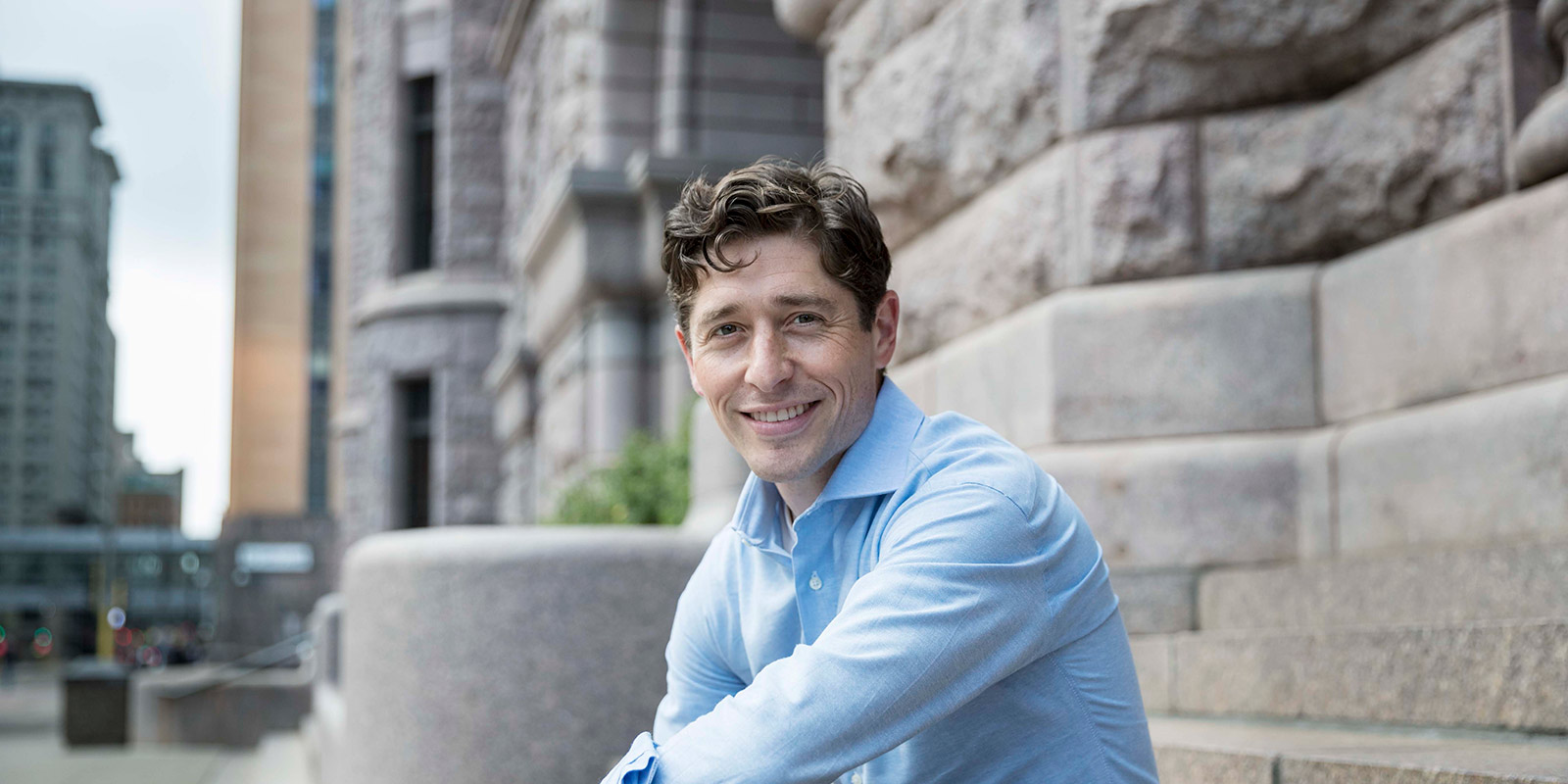
2008 Budget Message

Mayor R.T. Rybak

Tuesday, August 15, 2007

Every day in Minneapolis there are moments when thousands of us cross paths without ever seeing who we are. People walk by on the sidewalk or in a skyway without saying hello. Cars switch lanes in heavy traffic without paying attention to who is behind the other wheel. We are nearly 400,000 people living in the same place but often don’t know who we really are.

Then something happens that forces us to look up from our daily routine to see what and who is really around us.

That happened dramatically, and tragically, at 6:05 August 1.

Today all of them are gone.

Others who were there are thankfully still alive: the kids on that bus from Waite House and a hero who helped save them; scores of people rescued by our police and firefighters.

All these separate lives, intersecting for one tragic moment in Minneapolis, are now frozen together forever. It’s during times like these that we realize we really aren’t all that separate after all. We realize that in the middle of a tragedy, and every moment of every day, we all share common ground.

This horrible incident taught us that lesson, as Minnesotans, as a common people. But there is also a special message for us in government, especially those of us in city government. In Minneapolis city government we provide that common ground: we build and maintain roads, bridges and sidewalks. We provide the common services we all share: public safety, public water, garbage removal, snowplowing, public housing, libraries, schools and parks. We provide opportunity for our common aspirations: good jobs, a strong economy, and business investment.

We also provide protection and rescue in times of disaster, and in the face of one of the worst disasters we could ever imagine, Minneapolis performed brilliantly. To our heroic police and firefighters, to our remarkably well-prepared Emergency Preparedness Team, to the hundreds of emergency responders and public employees we owe a tremendous round of thanks.

In these weeks, we have, once again, shown the entire country, and even the world, that Minneapolis is a city that works.

Over these next few weeks, as the Legislature hopefully goes back into session, and I complete the budget that, hopefully, will be helped by some restoration of local government aid, we should also remember another lesson of this tragedy: when you invest in quality government you get quality results. When you don’t invest, there are consequences.

We now all know that we have not invested enough in roads and bridges in this country, in this state and in this city...and no matter what we discover about why this bridge collapsed, it’s clear our underinvestment has had serious consequences.

We did invest in emergency preparedness and look at the result. Soon after 9/11, you and I and dozens of other top city officials spent a week at the National Emergency Training Center in Mount Weather, Virginia at a Minneapolis-specific emergency management course. Following this training, we identified a series of shortcomings and inefficiencies and immediately started working on ways to address them. Our actions included:

In all, over the last five years, we invested over $50 million to improve Minneapolis’ ability to quickly and effectively respond to any type of emergency. It is crystal clear today that our efforts paid off. When you invest in quality government, you get quality results.

The country’s new - and long overdue - look at underinvestment in bridges, roads and transit should also illustrate that government can’t build and maintain infrastructure overnight. It takes long term, consistent investment, even when there isn’t a constituency lobbying for more money.

An example of that is our public water system. Fourteen years ago, the "disaster of the moment" was an outbreak of cryptosporidium in the Milwaukee drinking water. In that moment, people were talking about public water like they are talking about bridges today. The drinking water news soon died down, but our city didn’t lose its focus. Since 2001 we invested $140 million dollars to build Minneapolis’ state-of-the art ultra-filtration water system. Now, when many people in the country are finally realizing that you can drink water out of your tap instead of buying it in plastic bottles that clog our landfills, people in Minneapolis can brag about having some of the best public drinking water in the country.

Our ability to make these long-term quality investments in city government have been deeply challenged in the past few years. In 2003, when the state legislature cut $37 million a year from Minneapolis, we had to make some very difficult decisions. We made public safety our number one priority and to do that every other part of the city budget had to suffer, and in some cases the sacrifices were dramatic. That was the right thing to do and we are beginning to see results.

We have met the challenge of crime with a multi-faceted plan of attack that has begun to crack down on repeat criminals, break up juvenile gangs and reform problem properties:

These strategies constitute one of the most aggressive attacks on crime underway anywhere. The results of our efforts are beginning to be seen. Through the first half of 2007, for the first time in years, violent crime is falling, down 14 percent city-wide and trending downward in every police precinct. While the bulk of our crime – and our crime fighting efforts – continues to be concentrated in north Minneapolis, there we are also seeing progress. Violent crime is down 19 percent in north Minneapolis’ 4th police precinct so far this year.

Although we are continuing to see our crime rate decline, we will not stop strengthening our fight against crime. We are making progress, but we have a long way to go. The recent rash of 6 homicides in 11 days and the unacceptable concentration of murders in North Minneapolis are vivid reminders that we have much more work ahead to make our city safer for everyone.

We are making progress on public safety, but we must keep a laser-sharp focus on our top goal of making every part of Minneapolis A Safe Place to Call Home. Doing that will mean more sacrifices. It will mean tough, consistent police work, it will mean more focus on upstream solutions, it will require stronger financial management in the police department – and it will still mean more money.

We need to keep that our top budget priority, but that does not mean just money for police. We also need more funding for all those things that make our police more effective: more 911 operators, more community prosecution and restorative justice, and more focus on preventing youth violence.

Making these critical investments in public safety, during a time when the state was making massive cuts to Minneapolis, meant sacrifices in every part of our city. No area has suffered more than Public Works, and the critical task of building and maintaining our infrastructure. We have underinvested in resurfacing our roads and we have underinvested in repairing our sidewalks. The startling collapse of the 35W bridge also requires us to take a tough new look at the condition of our own bridges and it also requires us to take action when we see a problem.

We know we can’t delay this work any longer, but I honestly can’t tell you how we will step up to this challenge – and the challenge of public safety, and the other critical things we need to do – in the current financial climate. The Legislature delivered on their promise to help, and passed a tax bill that would have restored 14 million dollars of the local government aid that was cut, but the Governor vetoed the bill. Since that veto, and before the bridge disaster, I spent most of the summer in budget meetings and, frankly, it wasn’t pretty.

We can’t stop investing in public safety, not when we are finally seeing results, and we can’t delay our work on infrastructure any longer. We also can’t push our tax policy any further, especially not when our taxpayers have had to endure consistent property tax increases to replace lost state funds, and especially not when the Governor vetoed property tax relief.

This is why it is absolutely critical for the Governor and the Legislature to go back into special session and restore local government aide. During these past few years, when the state have shifted more and more of its burdens onto local governments, the citizens of Minneapolis, the citizens of St. Paul and the citizens of cities around the state have had to make major sacrifices. The bills are coming due, and I hope we have finally learned our lesson about what happens when you put off needed investments in the common good.

As the world watched the tragic disaster on the Mississippi River, the world saw that Minneapolis is a city that works. But we not only showed top-notch response to a crisis, we also showed how a city, a county, a state and a federal government can work together to get the job done. I strongly believe that the best way we can show respect for those lost is to make the tough decisions that lie ahead with dignity, sustained compassion – and continued cooperation.

These partnerships are needed when we face a crisis, but they are also needed to seize great opportunities. We see that with the announcement yesterday that our city and state are receiving $133 million from the federal government for our Urban Partnership Agreement. This is one of the most significant advancements in transportation in this region in many years. It only happened because mayors, council members, legislators and citizens along the 35W corridor stopped arguing about what we didn’t want on 35W, and instead agreed on a big vision for what we want.

The result is bus rapid transit and congestion-reducing pricing from Lakeville to the heart of downtown. It is also about realizing the vision of our Access Minneapolis plan: in just two years Marquette and Second Avenues will be completely rebuilt: wider sidewalks, more amenities for pedestrians and bus riders, buses moving must faster through downtown, which should mean fewer people driving alone in their cars. It also will allow us to take many buses off Nicollet Mall, leaving only low emission hybrid buses and bikes.

We should not stop there. The deep divisions in our region and state have deeply hurt our city, but in these past few weeks we have shown that Minneapolis and Minnesota can have one vision that’s good for everyone.

I will speak in more detail about these and other city investment when I deliver my complete budget next month.

I want to finish with a final thought on the bridge collapse. Several hours after it happened I was at a press conference and said this would probably be the greatest disaster in the city’s history. I was wrong. The loss of life was tragic, but thanks in part to our response, the disaster was nowhere nearly as bad as it could have been.

The greatest disaster in the city’s history remains the explosion at the Washburn A Mill in 1878, just upriver from the 35W Bridge. Eighteen workers died and the explosion was so loud it cracked windows miles away. More than one third of the city’s milling capacity was destroyed.

Milling was our main industry, this was our most important mill and in the wake of the disaster on the riverfront 140 years ago, people asked whether this young city on the Mississippi could survive.

The rest is history. Minneapolis came together to rebuild and we became a greater city than we were before the incident.

We will rebuild again.

Minneapolis continues to mourn today. But we should also be proud. With the whole world watching, we proved that Minneapolis is a city that works. Our job now is to prove that fact both in the middle of a disaster, and every day.

Thank you.

Last updated Sep. 27, 2011